Planning your rabbit control? Find out which control methods you can use this season and what’s changing with K5 calicivirus-treated carrots.

Latest News -
Planning your rabbit control without Calicivirus
Feral rabbits remain one of the most destructive pest animals in Australia, causing erosion, damaging native vegetation and competing with livestock for feed. They also have significant impacts on revegetation projects, farms, gardens and biodiversity across the Hills and Fleurieu.
Rabbit biocontrol programs have been very successful in the past. Many landholders will be aware that RHDV K5 (calicivirus) treated carrots have been available through Landscapes Hills and Fleurieu distribution days in recent years. However, we are pressing pause on providing calicivirus-treated carrots during the 2026-27 season.
Research and feedback from ongoing rabbit control programs indicate that the K5 strain of calicivirus has become less effective over time, with rabbit populations developing increased immunity. While K5 calicivirus-treated carrots will not be available during the 2026-27 season, national research is now being funded to identify and assess the next generation of rabbit biocontrol agents. These tools are valued by many landholders because they specifically target rabbits without harming other animals. The use of K5 calicivirus will be re-assessed in the lead up to the 2027-28 season.
In the meantime, the most effective way to manage rabbit populations is through an integrated approach that combines multiple control methods.
1. Choose a mix of control methods
Feral rabbits can quickly adapt if only one method is used. Combining strategies such as fencing, baiting, warren destruction and habitat modification gives you the best chance of success.
Think about the layout of your property, the scale of the problem and what resources you can commit. Using several methods together generally delivers better long-term outcomes than any single control technique alone.
2. Protect your revegetation and gardens
Rabbit-proof fencing is effective for smaller areas and properties, particularly around revegetation sites, vegetable patches and young trees. Excluding rabbits from these areas helps ensure your investment in protecting or restoring vegetation is not wasted.
Individual tree guards can also provide effective protection for small tubestock plantings, although rabbits may still browse vegetation that grows beyond the top of the guard.
While fencing can appear expensive initially, rabbit management is an ongoing task. In the long term, a staged approach to fencing may prove a worthwhile investment.



3. Remove shelter and destroy warrens
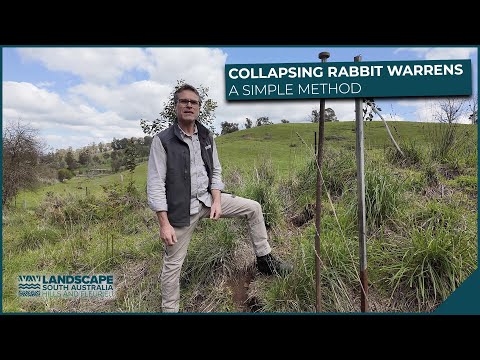
Rabbits need shelter to survive and breed, especially in the heat of summer. Destroying or collapsing warrens where possible is one of the most effective long-term control methods.
It's also important to remove piles of branches, green waste, pallets and other materials that provide cover. Reducing shelter makes your property less attractive to rabbits and limits opportunities for breeding.
Vacant warrens can quickly be reoccupied, so if complete destruction isn't possible, blocking entrances with rocks or other solid material may help reduce use.
If you are concerned that native animals have occupied a warren set up trail cameras to confirm what is using the warren.
4. Use baiting where appropriate
Baiting can be highly effective when carried out at the right time following best practice and as part of a broader rabbit management program. Your property must be over 1000m2 to meet the label requirements for use.
Available options include:
- Pindone-treated carrots available from Landscapes Hills and Fleurieu distribution days between December and April.
- Pindone-treated oats available through some hardware and agricultural supply stores.
Baiting is generally most effective during summer when natural food sources are limited and rabbit numbers are easier to target. However, baiting should not be viewed as a stand-alone solution and works best when combined with warren destruction, harbour removal and exclusion fencing.
Before purchasing Pindone baits through Landscapes Hills and Fleurieu distribution days, landholders must complete mandatory online training each year to ensure safe and effective use and minimise the risk of off-target impacts.

5. Make it a team effort
Rabbits don't stop at property boundaries. Working with neighbours can significantly improve the effectiveness of control efforts and reduce the risk of reinfestation.
Even simple conversations about timing rabbit control activities can make a big difference. When neighbouring properties work together, the benefits are often greater and longer lasting.
Learn more about steps you can take to control feral rabbits and to register for the mandatory online training and bait distribution days here.