The Landscapes Hills and Fleurieu office will be closed on Wednesday 21 October and will reopen on Thursday 22 October. Our phones will not be monitored during this time

Updating the Eastern and Western Mount Lofty Ranges Water Allocation Plans
 Back to projects
- Project status Current
The Water Allocation Plans for the Eastern and Western Mount Lofty Ranges have been reviewed and are now being amended.
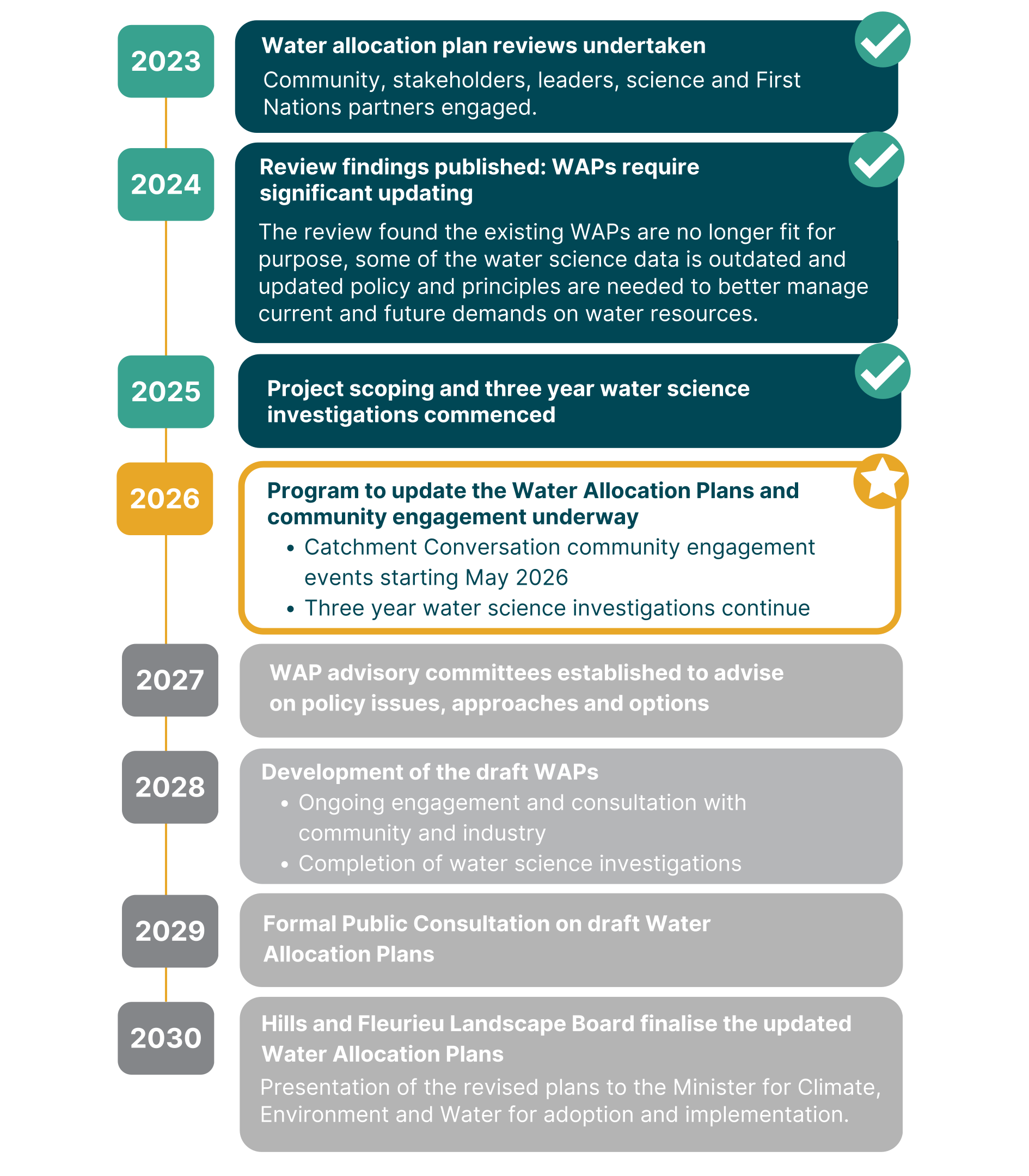
The process to amend these plans began in 2025 and is expected to continue through to 2029, resulting in updated Water Allocation Plans for both regions.
This is an important opportunity to reflect on how water is shared and used across our catchments, and how different uses collectively affect natural flow paths, farms and aquatic ecosystems. Healthy creeks and rivers support native species, productive landscapes and resilient communities, and achieving this relies on shared solutions.
Supporting sustainable water use into the future may involve practical changes on the ground, as well as ongoing conversations about how we value and manage water across our communities.
Planning for climate change is also essential, as rainfall patterns shift and water availability becomes less predictable.
Throughout the amendment process, all water licensing business will continue as usual. The Department for Environment and Water remains your key contact for all licensing matters.
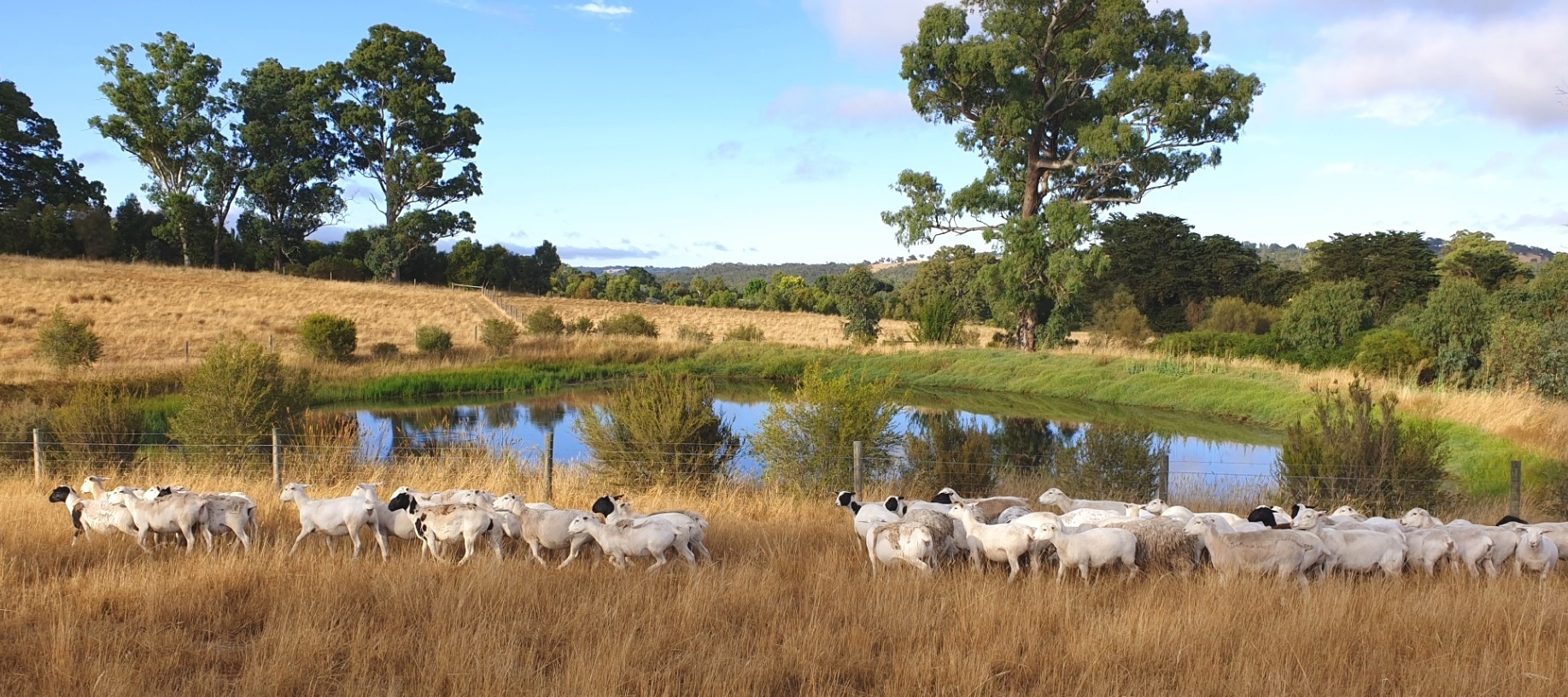

Join a Catchment Conversation
Help shape future Water Allocation Plans across the Hills and Fleurieu.
We’re updating the Water Allocation Plans for the Mount Lofty Ranges and would love your input. Join a local catchment conversation to talk about water issues in your area and what should be considered in future planning.
What we're hearing at our Catchment Conversations
As we continue our Catchment Conversations across the region, we're hearing thoughtful and passionate feedback from landholders, water users, community members, industry representatives and local organisations. These conversations are an important part of the process to update the Eastern and Western Mount Lofty Ranges Water Allocation Plans.
While several sessions are yet to be held, some common themes are beginning to emerge. Read about them below or watch a short video summary here.
Food production and regional economies matter
Water plays a critical role in supporting food production across the region, and many conversations have highlighted the close connection between water security, agricultural productivity, employment and regional prosperity.
- The importance of protecting the region's capacity to produce food into the future.
- Concerns about the potential impacts of water availability on agricultural industries, including horticulture, viticulture and livestock production.
- Recognition of the contribution agriculture makes to local jobs, businesses and regional economies.
- Maintaining water access entitlements to support existing enterprises, future generations and evolving land uses.
- Balancing environmental outcomes with the ongoing viability of food production across the region.
Business confidence is affected by uncertainty about future water entitlements
Conversations have highlighted concerns from some licence holders around future water entitlements and other WAP policies currently in place limiting activities which require ‘new water’.
- Recognition that water licences are valuable assets that support farming businesses, investment and property values.
- Questions about how any future allocation changes might be determined, shared and implemented.
- Interest in understanding how future changes could affect business planning, borrowing capacity and long-term investment decisions.
- Maintaining flexibility for future farming opportunities, business growth and changes in land use.
- Interest in how water trading arrangements operate and how access to water may be affected in the future.
- The importance of fairness, transparency and certainty in future water allocation and licensing arrangements.
Local data and knowledge matter
One of the strongest themes emerging from the conversations is the importance of robust local data and evidence-based decision-making.
- Interest in groundwater, creek and river flows, water quality, groundwater recharge, and the science and monitoring that underpin water planning.
- Support for greater access to timely, high-quality data, supported by effective analysis and modelling, to provide a clearer picture of water resources and support better and more transparent decisions into the future.
- A desire for decisions to be informed by reliable information that communities can understand and trust.
- Support for sharing data and information with landholders and local communities to help explain how decisions are made and why changes may be necessary.
- Recognition of the value of combining scientific information with local knowledge and lived experience.
- A stronger understanding of how decisions are made and the evidence used to support them, recognising that both data and on-ground observations have an important role to play in water planning.
Water security remains front of mind
Water security continues to be a key topic across the region, reflecting the important role water plays in supporting farming businesses, food production, employment and local economies.
- Questions about how changing conditions may affect long-term water availability, local businesses and future investment.
- Interest in alternative water sources, water trading arrangements, storage options and other approaches that could contribute to water security in the future.
- The importance of maintaining access to water to support existing farming enterprises, future changes in land use and opportunities for the next generation.
- A strong desire to protect the region's ability to farm and grow into the future.
- Certainty around future water planning.
- Questions about how future changes could affect farming businesses, property values, investment decisions and opportunities for future generations.
- Long-term assurances to help farmers plan and manage for the future, particularly in the context of climate change and the ongoing need to adapt to changing conditions.
People want to be part of the conversation
Another consistent theme is the desire for an open and transparent process.
- Understanding how decisions are made, how feedback will be considered and how communities can stay involved throughout the journey.
- Recognition of local knowledge, lived experience and early communication as important parts of the process.
- Support for engaging early, before any potential changes are developed or considered.
- The importance of a balanced and inclusive process, with equal representation across stakeholder groups.
- A strong focus on scientific evidence to inform decision-making.
- Transparency, access to information and regular communication throughout the planning process.
- Opportunities to help shape future outcomes, rather than only providing feedback once options have been developed.
Healthy environments and productive landscapes are closely connected
Many people have highlighted the importance of healthy creeks, rivers, wetlands and ecosystems, and the strong connection between environmental, agricultural, cultural and community outcomes.
- Concerns about declining streamflows, water quality, biodiversity loss and the resilience of catchments under a changing climate.
- Recognition of the importance of maintaining productive landscapes, thriving communities and regional livelihoods.
- Concerns that catchments are becoming drier, development pressures are increasing, and pollution is affecting waterway health and biodiversity.
- A desire to balance healthy environmental outcomes with ongoing water use.
- Recognition of the importance of both protecting natural systems and supporting communities, businesses and food production.
- The need for fairness and balance, ensuring there is enough water to maintain healthy ecosystems while also supporting thriving agriculture and regional communities.
- Recognition of the close connection between environmental, human and community wellbeing.
- An understanding that healthy environments underpin healthy communities, economies and livelihoods.
- Recognition of the value of Traditional Owner perspectives in discussions about water and environmental management.
Growth and changing demand are important considerations
Many conversations have explored how population growth, urban development and changing land uses are placing additional pressure on water resources.
- Questions about how water is shared across different sectors and how water planning can respond to changing demands in the future.
- Discussion about development, forestry, tourism, stock and domestic water use, water trading and future growth.
- Recognition of the complex range of factors that influence water management across the region.
- Support for water allocation plans that remain flexible and responsive to changing climate conditions and the unique characteristics and needs of different catchments.
- Interest in understanding how decisions may affect different water users, industries and communities.
- Water planning that considers a broad range of perspectives and balances environmental, social, cultural and economic outcomes.
The conversation continues
While these themes are emerging across multiple catchments, we know there are still many perspectives to hear. With more Catchment Conversations still to come, we encourage anyone interested in the future of water in our region to get involved.
Everything we're hearing is helping us better understand the values, concerns and aspirations communities have for their water resources. This includes differing views about the challenges facing our catchments and the opportunities available to respond. This feedback will help inform changes to the water allocation plans, supporting a balance between healthy environments, resilient communities and sustainable water use.


How do the plans get amended?
Amending the Mount Lofty Ranges plans is a staged, multi‑year process. New science information will become available over time, and that evidence, alongside community knowledge and values, will help shape future management options. No decisions have been made yet, and this work will progress in steps, with opportunities for discussion and input along the way.
The section below explains what we’ve learned so far, how the amendment process works and how you can stay involved.
The Eastern and Western Mount Lofty Ranges Water Allocation Plans are legal documents that provide the regulatory framework for responsible, fair and equitable water allocations for users of surface, watercourse and ground water resources, whilst supporting the health of our landscapes and ecosystems.
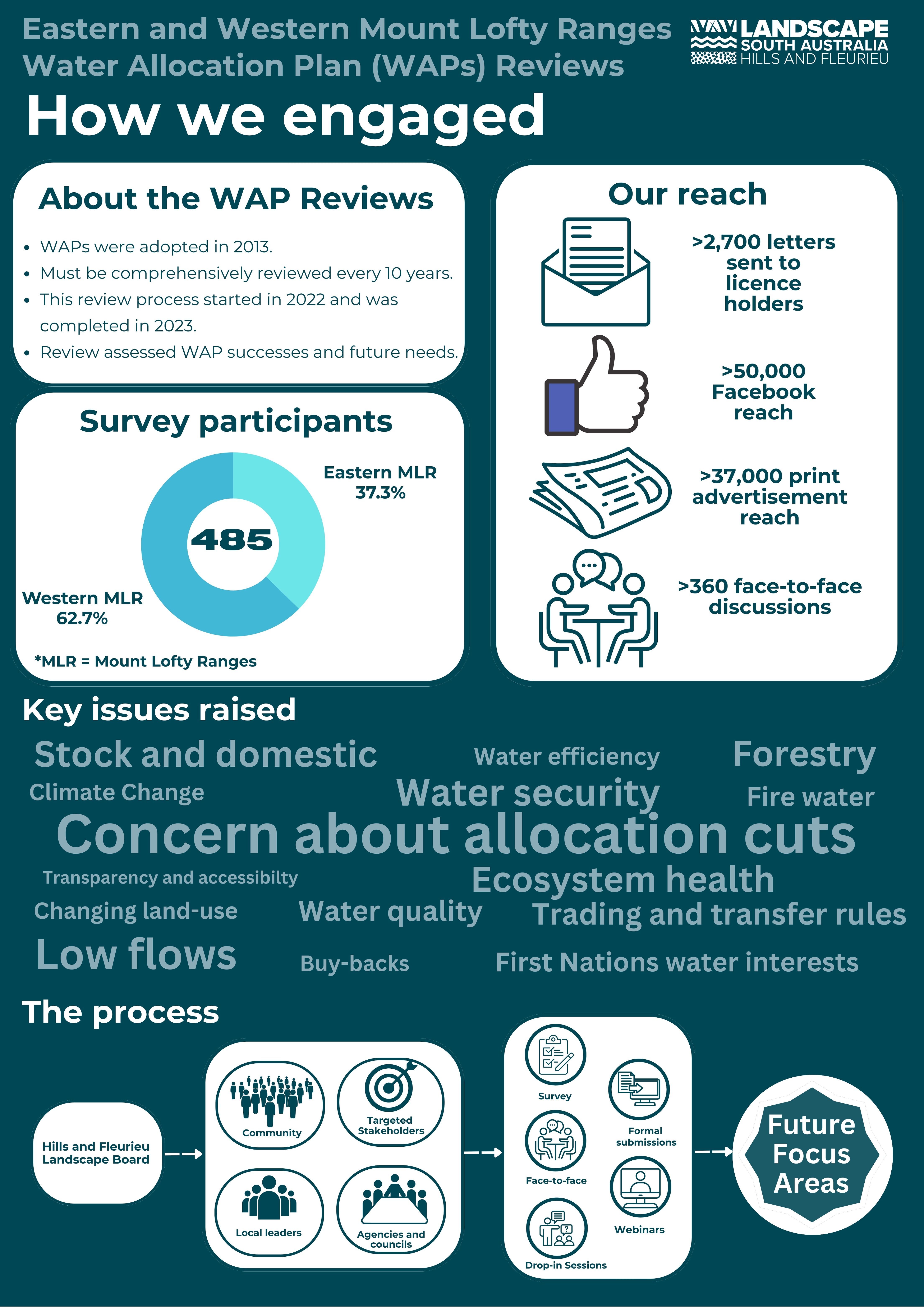
The water allocation plan must be reviewed within 10 years of adoption to ensure it is still effectively managing the risks to the water resource, the environment and the community. Reviews on the existing Eastern and Western Mount Lofty Ranges WAPs took place between 2022 - 2024 and found they are no longer fit for purpose, as they rely on outdated rainfall data, do not reflect increased climate variability, and are based on an unsustainable water balance.
Amending the plans is a complex, multi-year process underpinned by community and cultural values, new knowledge, data and science.
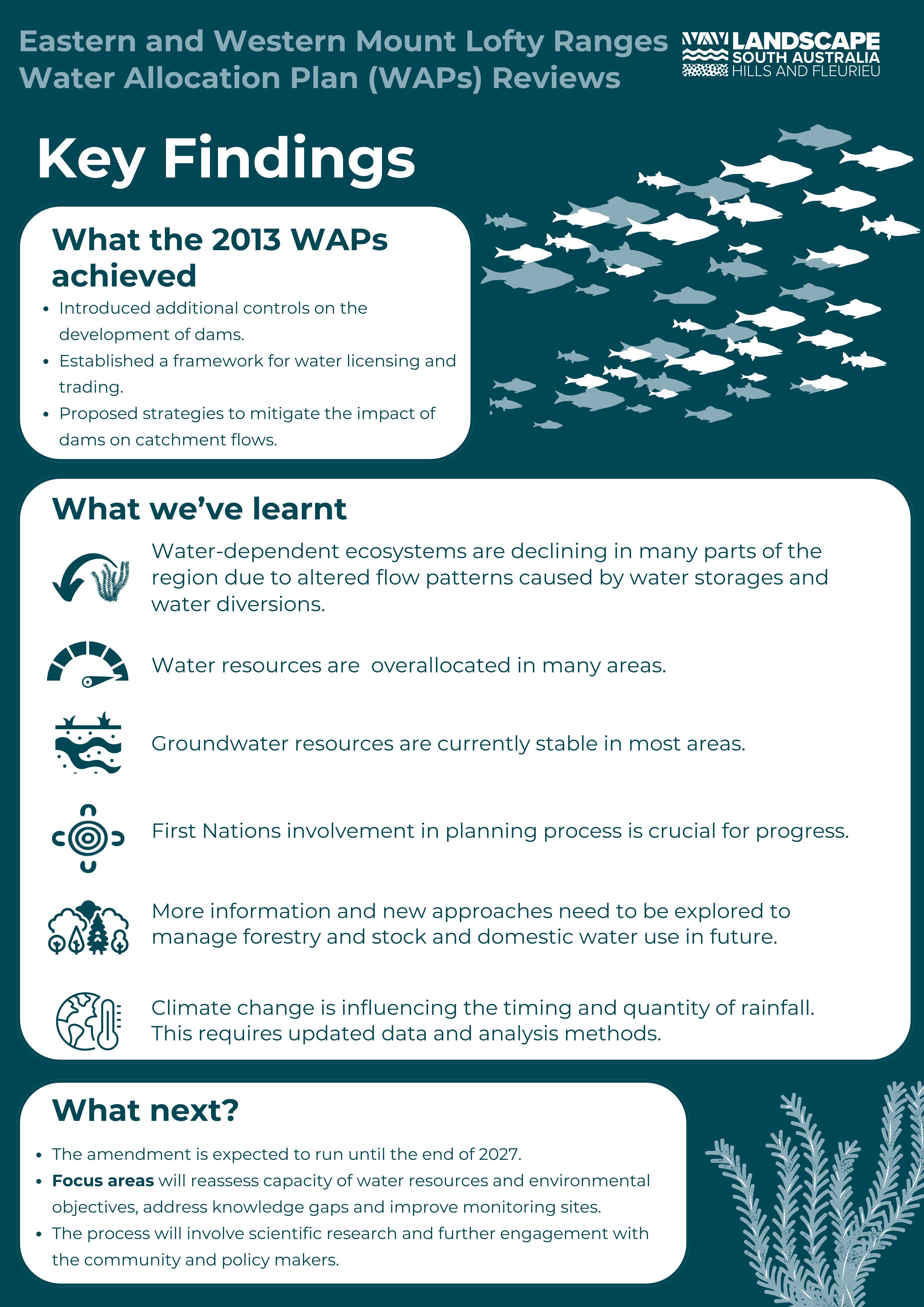
Findings of the review of the 2013 Water Allocation Plans
The review of the current Water Allocation Plan's found that they were successful in:
Establishing a framework for water licensing and trading.
Introducing additional controls on the development of dams.
Proposing strategies to mitigate the impact of dams on catchment flows.
Key learnings of the review were:
Groundwater resources are currently stable in most areas.
Water-dependent ecosystems are declining in many parts of the region due to altered flow patterns caused by water storages and water diversions.
Water resources are over-allocated in many areas.
Climate change is influencing the timing and quantity of rainfall. This requires updated data and analysis methods.
First Nations involvement in planning process is crucial for progress.
More information and new approaches need to be explored to manage forestry and stock and domestic water use in future.
How the plans will be updated
The amendment process involves developing policy revisions or new policy elements in alignment with findings identified during the review process.
These revisions are developed with support from the Water Allocation Plan Advisory Committees. They are then further tested with stakeholders and community through consultation. Feedback from consultation may result in revisions being changed and then tested again with stakeholders and community. The process is iterative as revisions are interconnected.
The amendment phase has commenced and will involve detailed technical investigations to address knowledge gaps and will also include significant community engagement, including:
Forming Water Allocation Plan Advisory Committees (WAPACs).
Consulting targeted interest groups.
Engaging with communities in the Eastern and Western Mount Lofty Ranges.
We are mindful that water users need to be kept informed of the process and any changes that could impact their businesses so that they can plan and make informed decisions. Throughout the process we will ensure to communicate:
clear information about any imminent changes so that it enables forward planning for water users,
how the changes might impact water users,
the types and scale / extent of amendments that are required,
the type and source of information and evidence that will be used to address knowledge gaps during the amendment process, and
the intended outcomes of any amendments (i.e. how the balance between environment, business and social values/needs are weighted).
We will continue engaging with communities and interest/business groups as our understanding grows and can be applied. As the amendment process continues, we encourage you to stay informed and participate in upcoming opportunities.
Timeline
Be part of the conversation
We want to hear from a wide range of voices as we begin updating the Water Allocation Plans for the Mount Lofty Ranges. Local knowledge, lived experience and different perspectives all play an important role in shaping good water planning.
One of the key ways to get involved will be through our Catchment Conversation events. These are relaxed, informal sessions where community members can come together to talk about local water issues and what should be considered as planning moves forward. Learn more or find an event near you here.
If you have any questions or would like to learn more, please get in touch via our contact us page.
Sign up for updates
If you’d like to stay informed, you can sign up for updates as the process progresses.
Stay informed as we update the water allocation plans
Get email updates on progress, key milestones and opportunities to have your say as we work through the water allocation plan amendments.
Frequently asked questions
A water allocation plan (WAP) is a legal document which ensures the needs of the environment are taken into account when determining how much water is available to be taken and used for other purposes. Water allocation plans set out the amount of water available for use, how that water may be allocated to water users, rules around trade of water, and the types of activities permitted with that water.
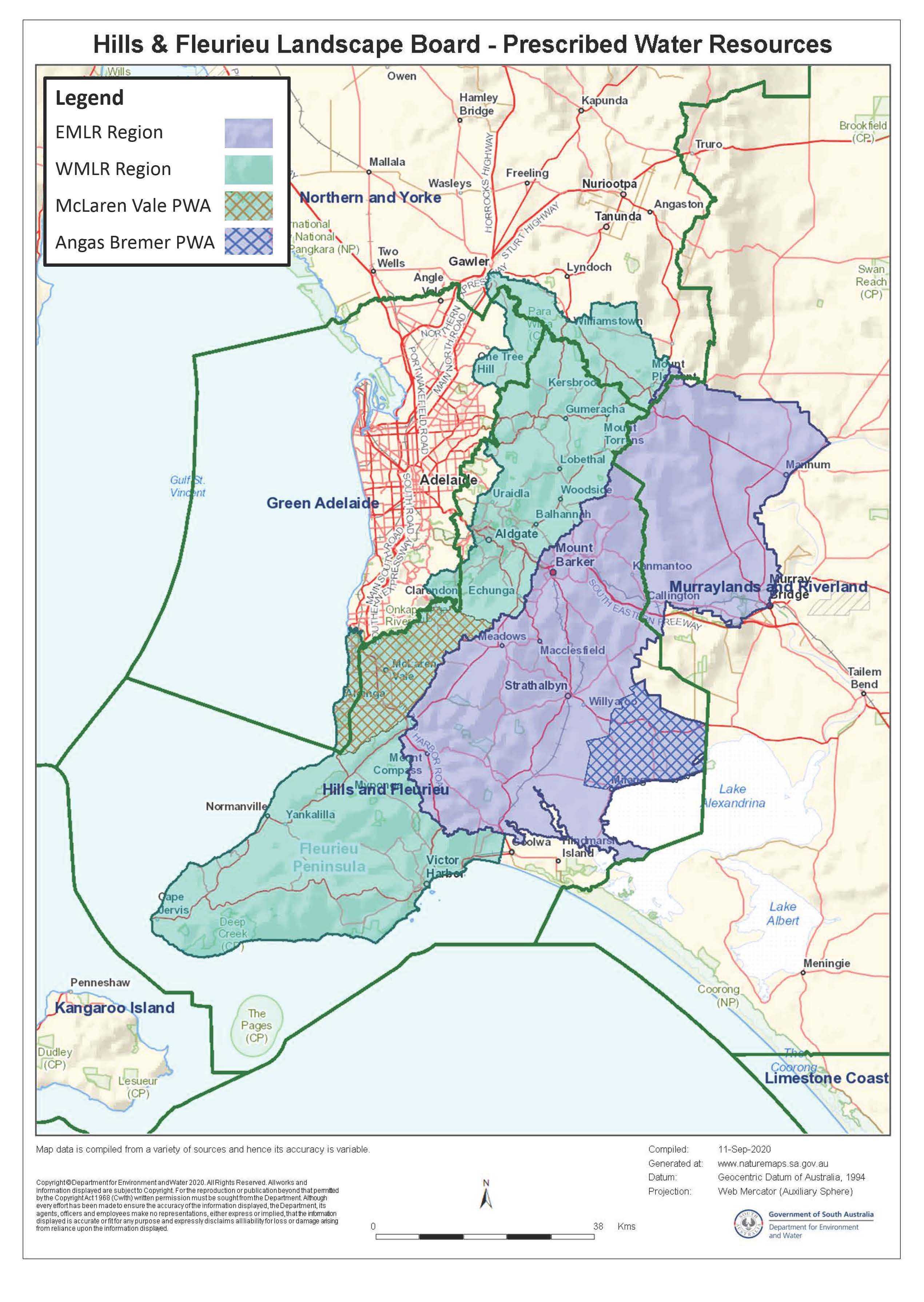
Both surface water and groundwater is prescribed in the Eastern Mount Lofty Ranges (EMLR) and Western Mount Lofty Ranges (WMLR).
Water allocation plans ensure the long-term sustainable, fair, and secure distribution of water resources among environmental, social, and economic needs. By setting clear rules for water usage and taking into account scientific data, WAPs manage the availability of water, support ecological health, and provide certainty for water users and for communtiies. community
The 2024 review of the Eastern and Western Mount Lofty Ranges WAPs found that amendments to the WAP policies are required to address gaps and limitations and to bring the science, policy and implementation
Water allocation plans are amended to update policies based on new scientific data, adapt to changing climate conditions, and ensure the sustainable management of water resources.
The recent review of the WAPs identified key focus areas which require revision to ensure that they remain appropriate to meet environmental and community need. We will work with community to identify water policy options and understand trade-offs between environmental, social and economic water needs
To support the process there is a program of water science underway which will inform us about the status and condition of the water resources in the prescribed areas, and the water requirements of the ecosystems which depend on water.
The Hills and Fleurieu Landscape Board will work with all interested stakeholders to ensure views are heard throughout the process of updating the WAPs.
Amending the plans is a complex, multi-year process underpinned by community and cultural values, new knowledge, data and science.
Currently the Board is investing in a program of water science to provide new knowledge which will inform the process to update WAP policies. For this reason we don’t expect to have new plans in place until 2030.
We will continue to communicate progress and there will be many opportunities to engage with us to share your knowledge and help shape policies in the WAPs.
The Hills and Fleurieu Landscape Board is keen to hear your perspectives on water planning in the region – what’s working, what’s under pressure, and how the plans can support water users into the future.
One of the key ways to get involved will be through our Catchment Conversation events. These are relaxed, informal sessions where community members can come together to talk about local water issues and what should be considered as planning moves forward. Learn more or find an event near you here.
If you have any other questions or would like to learn more, you can also get in touch via our contact us page.
Stay informed as we update the Water Allocation Plans
Get email updates on progress, key milestones and opportunities to have your say as we work through the water allocation plan amendments.
You might also like
-
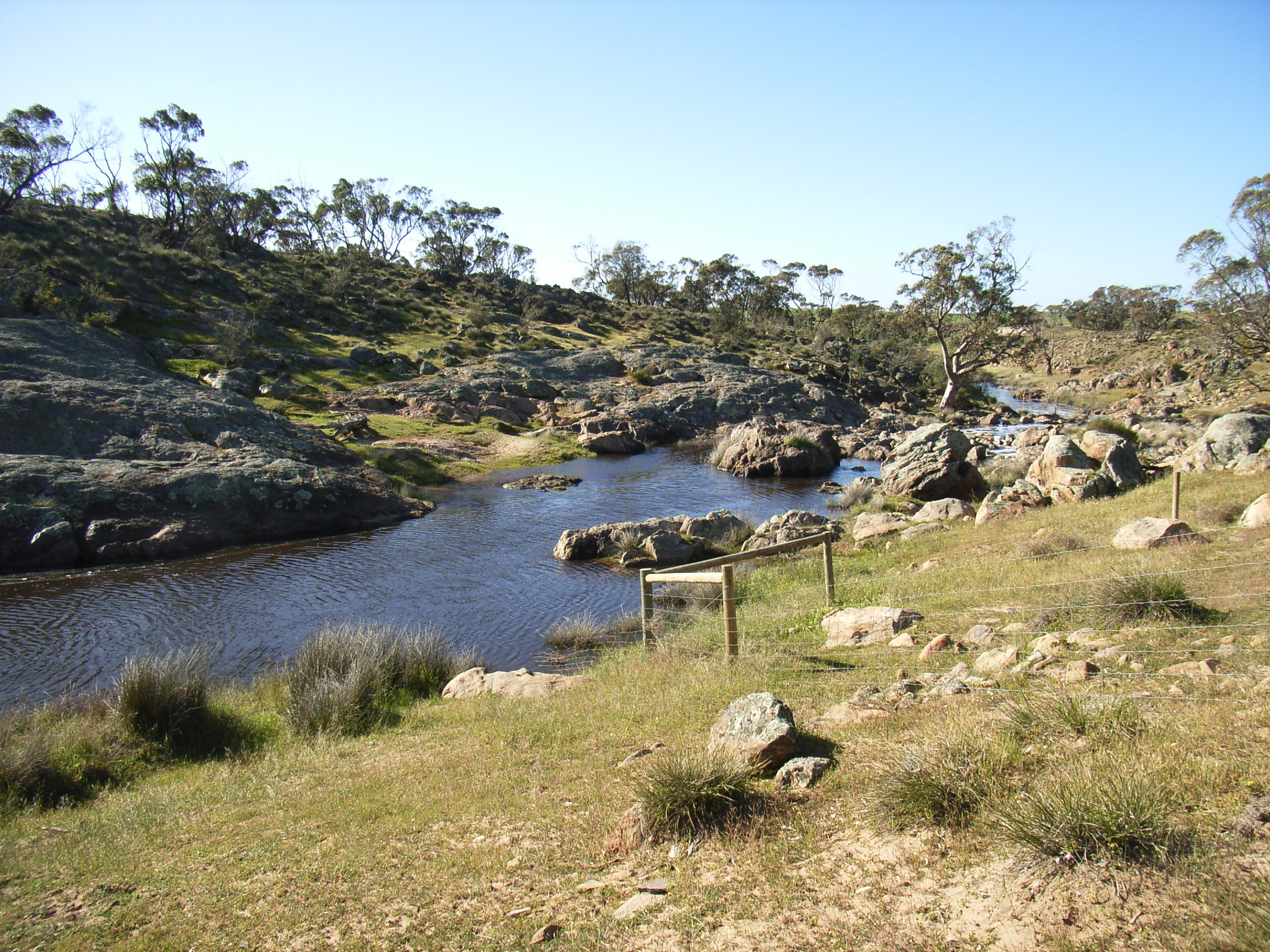
Western Mount Lofty Ranges Water Allocation Plan
Read More About Western Mount Lofty Ranges Water Allocation Plan
-
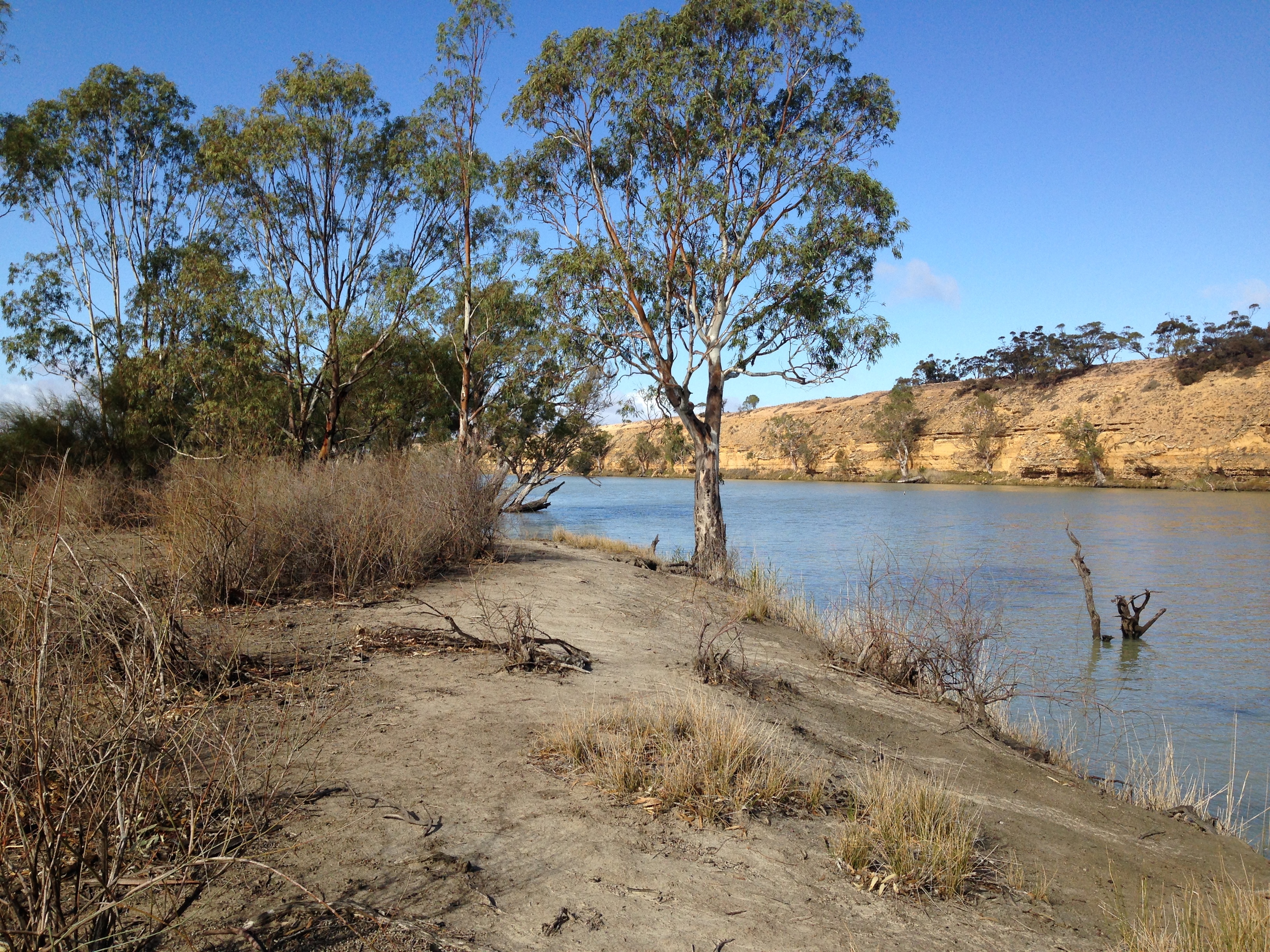
Eastern Mount Lofty Ranges Water Allocation Plan
Read More About Eastern Mount Lofty Ranges Water Allocation Plan
-
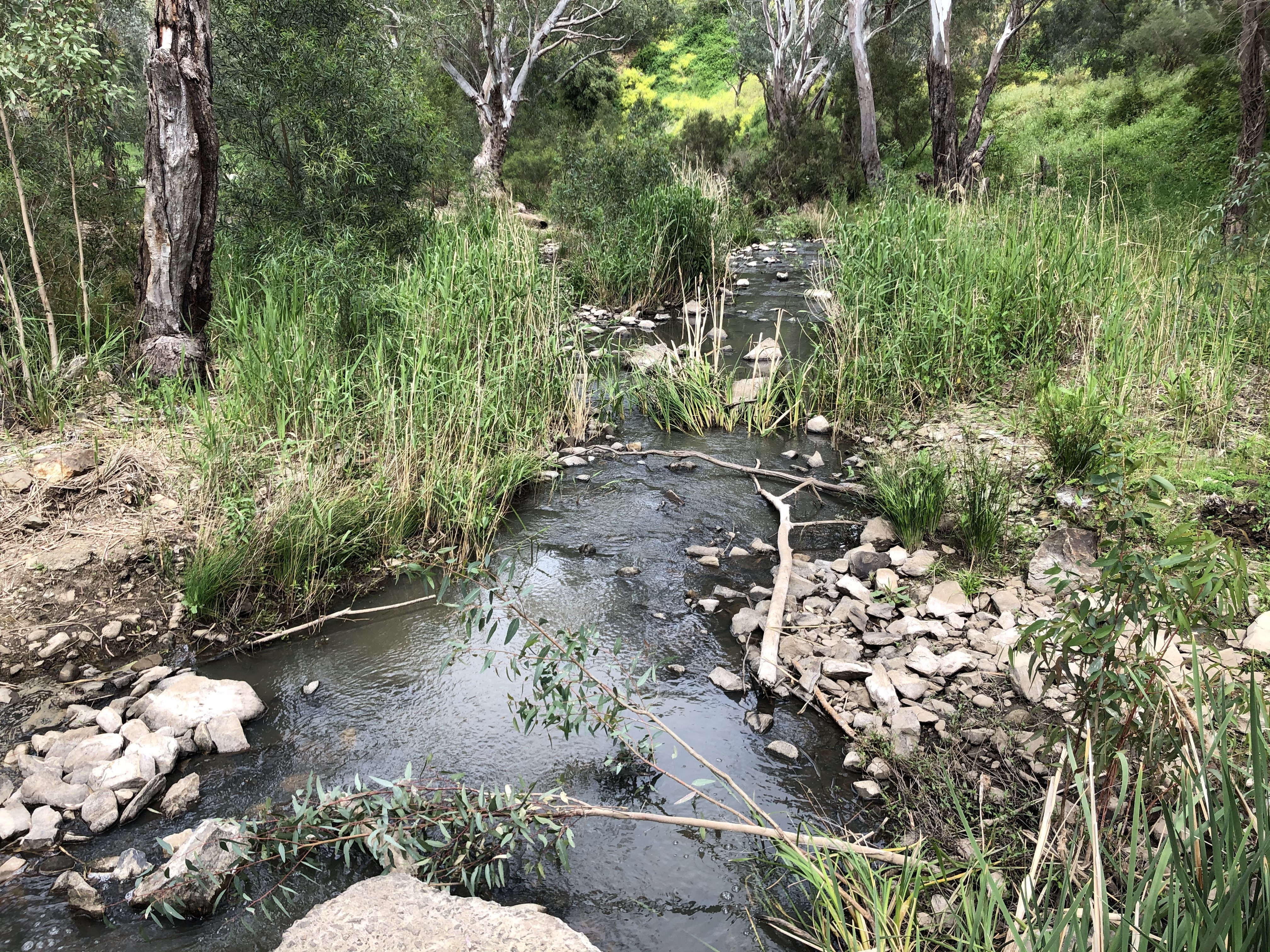
Review of the 2013 Mount Lofty Ranges Water Allocation Plans
Read More About Review of the 2013 Mount Lofty Ranges Water Allocation Plans
-
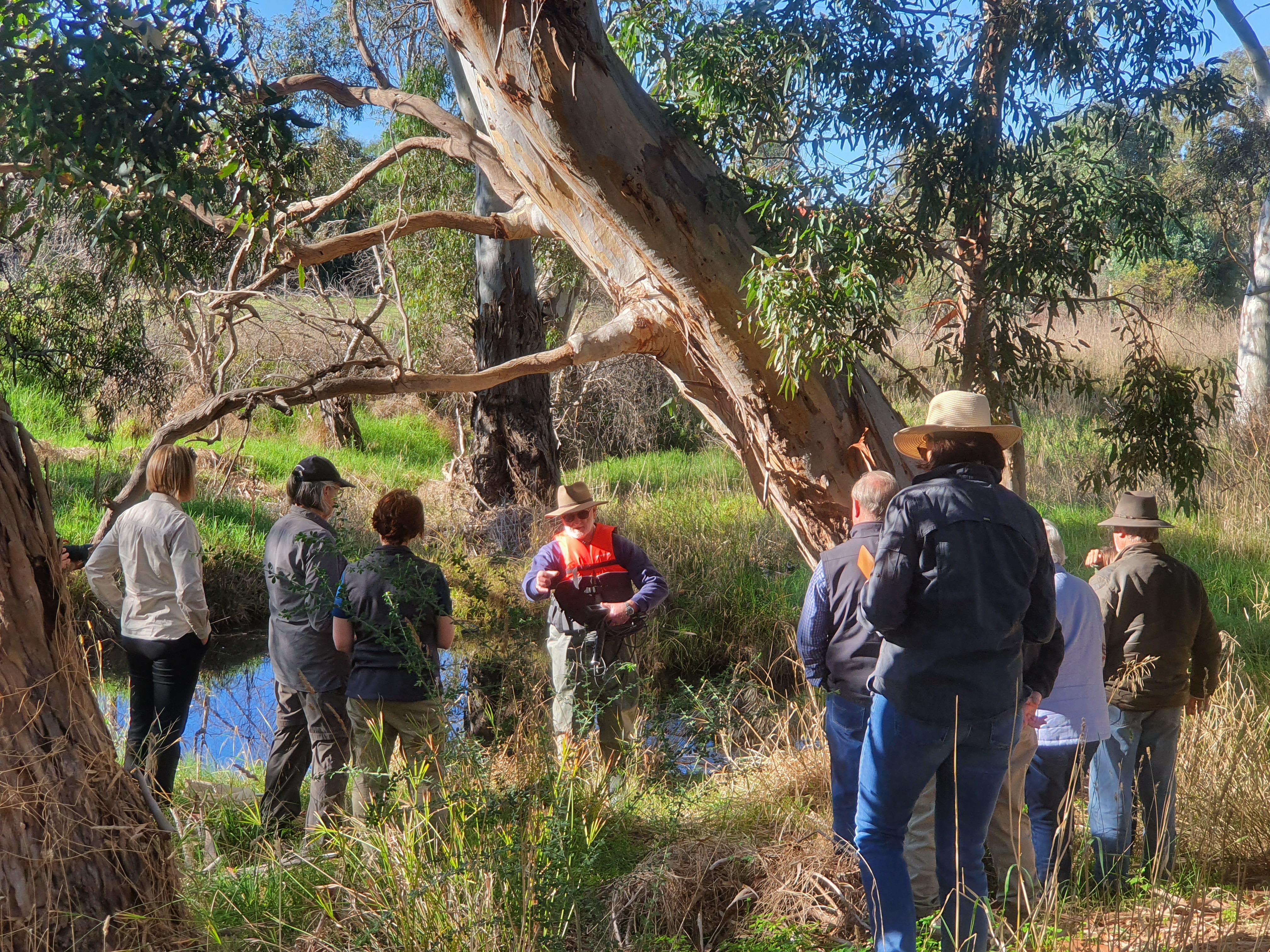
Join a Water Catchment Conversation
Read More About Join a Water Catchment Conversation
The Hills and Fleurieu Landscape Board is responsible for the review and amendment of the Eastern and Western Mount Lofty Ranges Water Allocation Plans (WAPs) in accordance with the Landscape South Australia Act 2019. The implementation of the plans is a shared responsibility with the Department for Environment and Water.